Top Tips for Boosting Game Retention and Keeping Players Engaged


In today’s competitive gaming world, player retention is one of the biggest challenges that studios may face, regardless of their size or renown. While acquiring new players is essential, keeping them engaged over time is what truly determines a game’s success.
Many mobile games struggle with low retention rates, which can lead to declining revenue, high churn rates, and an inability to build a loyal player base.
Research on retention metrics shows that games often lose a significant percentage of users within the first few days. Without an effective strategy, developers risk losing both current players and potential high-value players who could contribute to in-game purchases, community events, and organic growth.
Understanding game retention rates and how to improve them is crucial for better performance and increasing player engagement.
In this article, we’ll explore why game retention matters, key benchmarks, and practical strategies to retain users.
So, suppose you’re looking to re-engage lapsed players, keep retention high in the long run, or enhance your game’s progression system. In that case, these actionable tips will help you ensure a successful game.
Why Mobile Game Retention Matters
Nowadays, success doesn’t rely solely on attracting new players. You should also focus on keeping them engaged over time. Mobile game retention is one of the most important metrics for studios worldwide, as it directly impacts revenue, player engagement, and a game’s overall success.
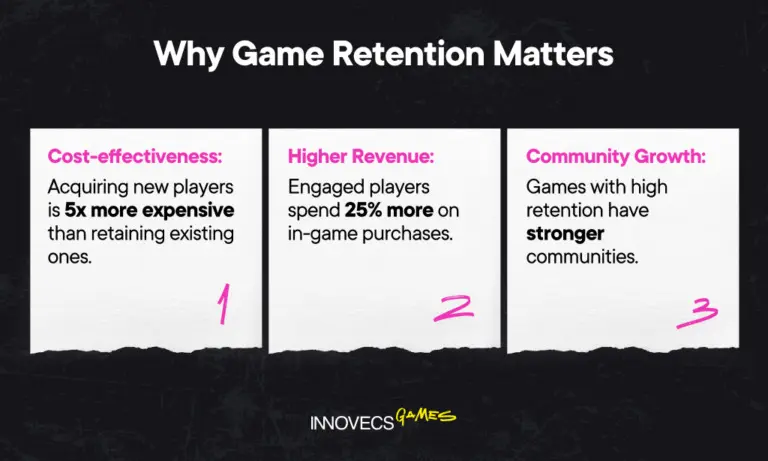
In general, gaming managers focus heavily on acquisition, so getting completely new players. However, acquiring new users is far more expensive than retaining existing players. Studies show that increasing player retention by just 5% can lead to a 25–95% boost in revenue. Games with higher retention rates also benefit from organic growth, as satisfied players encourage their friends to join.
Free-to-play games rely on purchases made in the game, meaning long-term retention is crucial for monetization. The longer you keep players interested, the more likely they are to make purchases, whether through cosmetics, progression system upgrades, or season passes.
On the other hand, poor retention means a shrinking player base, leading to fewer opportunities for monetization and lower initial retention rates in future updates.
Key Benefits of High Retention
- Sustainable Revenue: Engaged players are more likely to spend money in-game.
- Stronger Community Building: Social features and community events encourage players to stay.
- Better Player Feedback: Retained players provide valuable insights for game improvements.
- Higher Lifetime Value (LTV): Players who stick around contribute more over time.
- Increased Organic Growth: High levels of retention lead to word-of-mouth recommendations.
- More Effective Acquisition: Retaining high-value players allows for better ROI on marketing efforts.
As you can see, a prosperous game requires more than launching with a strong user base. You should also prioritize keeping that base engaged. Game retention rates directly influence long-term viability, and developers who prioritize strategies to increase retention will see better results in player satisfaction and revenue growth.
Understanding Mobile Game Retention Rates Benchmarks
Understanding retention benchmarks is crucial to increase retention in mobile games. Mobile game retention rates vary significantly based on several factors, including game genres, player demographics, and regional variations.
By analyzing mobile game retention benchmarks, you can set realistic goals, track performance, and adjust your strategy accordingly.
Retention rates typically follow a pattern where the first few days after download are critical. In general, mobile games experience a sharp drop in player engagement over time, but consistent efforts can mitigate this decline. The common mobile game retention benchmarks are as follows:
- Day 1 Retention: 35–40%
- Day 7 Retention: 10–15%
- Day 30 Retention: 5–10%
These numbers indicate the percentage of players who return to the game on Day 1, Day 7, and Day 30 after their initial install. While these benchmarks may seem low, games with impressive retention rates are able to keep a solid portion of players engaged through ongoing challenges, events, and social features.
Retention rates can also vary by game genre. For example, strategy games and paid games tend to have higher retention rates compared to casual games, which may see lower engagement in the long term. Paid ones often retain a dedicated core group of players, while free games may rely on lower retention in the early stages but benefit from long-term engagement through purchases and personalized messages.
It’s also important to consider regional nuances in retention benchmarks. For instance, games in Asian markets often show higher retention rates than those in Western markets, as players tend to engage with mobile games more frequently in regions like Japan and South Korea. Understanding these social aspects helps tailor the game’s content and engagement strategies for different regions.
Key Metrics to Measure and Improve Game Retention
Understanding and tracking the right metrics is essential to get better retention. By analyzing retention metrics, game developers can identify patterns, measure success, and refine their strategy to boost engagement.
Here are some of the most important key metrics to track for assessing and improving player retention.
Retention Rate (Day N Retention)
The retention rate is one of the most important metrics for understanding how many players return to the game after their initial play. The most common way to calculate retention rate is by using the formula:
Retention Rate = (Active Users on Day N / Installed Users on Day 0) × 100
This metric helps developers understand how engaging the game becomes over time. High levels of retention on Day 1 and Day 7 typically signal that the onboarding experience and initial gameplay are successful, while a sharp drop-off may suggest areas for improvement in engagement.
Daily Active Users (DAU) and Monthly Active Users (MAU)
Tracking DAU and MAU gives insights into how many players are actively engaging with the game on a daily or monthly basis. These metrics help developers evaluate overall engagement and whether their strategies are successful in keeping players coming back consistently. A strong DAU/MAU ratio indicates a high level of engagement and strong retention in the long run.
Churn Rate
The churn rate represents the percentage of players who stop playing the game within a specific period. This metric is crucial in understanding why players leave and helps developers focus on thinking of better retention strategies. A high churn rate suggests that players are not finding the game engaging enough or may feel the game isn’t rewarding enough to continue.
Lifetime Value (LTV)
Lifetime value (LTV) is a metric that measures the total revenue generated by a player throughout their engagement with the game. Players who exhibit good retention typically have higher LTV, especially in free games. By tracking LTV, developers can assess the overall profitability of their retention efforts and ensure the game’s sustainability.
By regularly monitoring these metrics, mobile game developers can make informed decisions to keep retention high and enhance the gaming experience for players, ensuring success.
10 Proven Strategies For Better Retention
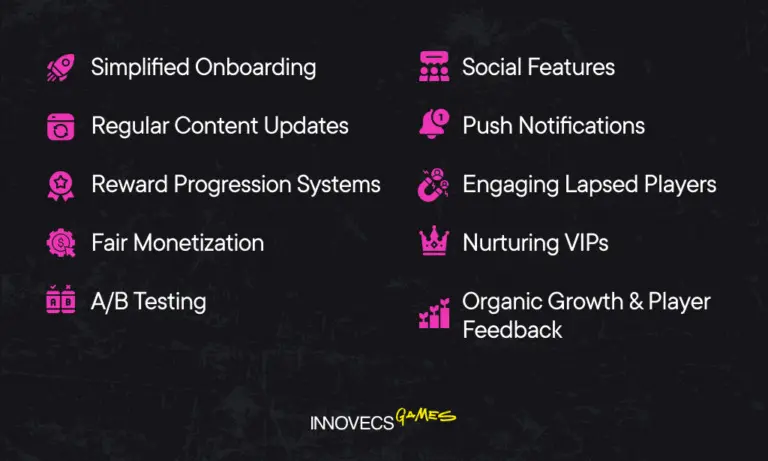
Improving retention is not a one-size-fits-all approach; it requires understanding your players and their preferences and continuously adapting your strategy. Here, we’ll explore 10 proven strategies that have been proven to boost retention and engage players. These tactics are backed by real-world examples from top games, helping developers maintain an active player base and drive revenue growth.
#1 Simplified Onboarding
The onboarding process is the first step in a player’s journey, and it’s crucial for retaining users. A complex or overwhelming introduction can lead to poor retention. To avoid overwhelming new players, keep the tutorial short and easy to follow and gradually introduce game mechanics.
Example: Clash Royale is known for its smooth onboarding process. It offers quick and intuitive tutorials that help players understand the basics and get started without feeling lost.
#2 Regular Content Updates
Players are likely to get bored if a game doesn’t offer fresh content. Regular updates, such as limited-time events, new levels, or seasonal challenges, keep players engaged and coming back for more. Keeping your game dynamic helps avoid player churn and encourages players to continue playing over time.
Example: Fortnite regularly introduces new seasonal events and limited-time content, ensuring that players are constantly exposed to new experiences.
#3 Reward Progression Systems
Players are more likely to stick with a game if they feel rewarded for their time and effort. Offering level-ups, unlocking special items, or earning rewards, creates a sense of achievement that drives engagement.
Example: World of Warcraft uses a robust progression system that motivates players to grind for rewards and unlock higher-level content, enhancing player retention.
#4 Fair Monetization
While in-game buys are an essential part of free-to-play games, players will quickly abandon a game if they feel the monetization is unfair or pay-to-win. Offering fair monetization – such as cosmetic-only purchases – ensures that retaining players is based on gameplay experience rather than forcing players to spend money to progress.
Example: Path of Exile is praised for its cosmetic-only model, where players can buy skins and cosmetic items without affecting gameplay, which keeps the game fair and balanced.
#5 A/B Testing
A/B testing allows you to experiment with different elements of the game (e.g., level difficulty, rewards, interface changes) to see what resonates best with players. You can continuously refine your game by analyzing the results to fix retention and engagement.
Example: Candy Crush frequently A/B tests different level difficulties and reward systems to ensure that players remain challenged yet not frustrated, boosting player retention.
#6 Social Features
Social features like friend referrals, team-based gameplay, and multiplayer modes can significantly improve user retention. When players can interact with friends and other players, they are more likely to stay engaged. Cooperative gameplay and competitive elements further enhance player retention.
Example: Pokémon GO integrates raids, trading, and team-based activities, which make players more eager to engage with one another.
#7 Push Notifications
Push notifications are a good way to bring lapsed players back into the game. They can keep players informed about new events, limited-time offers, or daily rewards when used correctly. However, it’s important to ensure that these notifications are personalized and relevant to each player’s preferences.
Example: Clash of Clans uses push notifications to alert players of available attacks, events, and rewards, encouraging them to stay involved.
#8 Engaging Lapsed Players
Players who have stopped playing need special attention. Re-engagement strategies, like come-back challenges, can offer them incentives to return to the game. These tactics help mitigate player churn and bring back users who might have otherwise forgotten about your game.
Example: Clash Royale offers come-back challenges for lapsed users, rewarding players for returning after an extended break.
#9 Nurturing VIPs
VIP players are those who spend the most time and money on your game. Retaining high-value players is critical to your game’s profitability. Offering exclusive rewards, early access to content, or personalized interactions can keep these players engaged.
Example: Clash of Clans nurtures VIPs by offering exclusive content and events tailored to high-level players, ensuring they remain active and invested in the game.
#10 Organic Growth & Player Feedback
The best form of growth comes from existing players. When players are highly engaged and enjoy the game, they will naturally recommend it to their friends, increasing both: your acquisition and retention rates. Encourage organic growth through referral programs, social sharing features, and positive word-of-mouth.
Listening to your players is vital to understanding their needs and improving the game. It’s very important regarding organic growth as well. Implementing player feedback through surveys or in-game voting can help developers identify areas for improvement and adjust to improve engagement.
Example: Among Us achieved massive organic growth thanks to streamers and social media, where players shared their experiences and attracted new users to the game.
Each of these retention strategies is designed to not only keep players engaged but also build a strong relationship between the game and its community. By implementing these tactics, developers can ensure they are not only attracting new players but also retaining players for the long term.
Another key to success is to continuously adapt your strategies and always keep the player’s experience at the forefront of your decision-making.
The Role of Paid Media
User acquisition and paid media play significant roles in driving growth for mobile games, but they also crucially impact game retention. Acquisition refers to strategies employed to bring in new players, while media involves using paid advertising to attract potential players. While these methods are essential for boosting the player base, retaining players over the long term is just as important for sustained success.
Effective acquisition strategies focus on attracting a large number of players and attracting those who will engage with the game in the long run. By targeting players who align with the game’s core audience and interests, developers can improve retention rates from the start. This approach ensures that newly acquired users are more likely to stick around.
Paid advertising, such as social media ads or search engine marketing, can also be used to re-engage lapsed players and keep the game’s success on track. Campaigns that focus on retaining high-value players can bring back users who may have stopped playing.
Additionally, paid media can highlight limited-time events, new content, or seasonal promotions that encourage players to return and continue playing.
While paid media is an effective method to attract players, developers must balance their efforts by implementing retention strategies that enhance user engagement and create lasting value. A high acquisition rate combined with strong retention strategies creates a sustainable ecosystem where players continue to engage and spend.
In summary, player acquisition and paid media are vital tools for expanding your player base. However, to ensure long-term success, it’s important to prioritize strategies that retain players and foster engagement.
Conclusion
In the ever-evolving gaming space, increasing retention is a continual challenge but one that offers substantial rewards. Developers can significantly improve engagement and ensure long-term success by implementing proven strategies such as regular content updates, rewarding progression systems, and building strong community features. Additionally, balancing acquisition and paid media with effective retention strategies is crucial for creating a sustainable player base.
However, game retention is not a one-time effort – it requires continuous optimization. Understanding people’s preferences, responding to feedback, and refining in-game mechanics based on crucial metrics will help developers adapt to evolving trends and keep players engaged. Leveraging social features, limited events, and personalized rewards further enhances engagement, ensuring a dynamic and rewarding experience.
Remember, retaining players is just as important as acquiring them. Prioritize player retention through a combination of data-driven insights, personalized experiences, and constant feedback loops. With these strategies in place, developers can ensure that players remain engaged, loyal, and invested in the game for the long haul, helping to maximize both lifetime value and game’s success.

Read next


