Essential Guide to EDI Standards: Types, Benefits, and Implementation


This comprehensive guide explores EDI standards (Electronic Data Interchange), detailing their types, benefits, and implementation strategies across industries. It begins with an introduction to EDI, explaining how standardized formats help businesses exchange electronic documents like invoices and purchase orders efficiently. The article covers widely used standards such as ANSI X12, UN EDIFACT, TRADACOMS, and HL7, highlighting their use cases in sectors like retail, healthcare, and logistics.
It also explains how EDI works – from data mapping to transmission protocols – and addresses common implementation challenges such as high costs, technical complexity, and partner compatibility. The guide concludes with a forward-looking view on how EDI is evolving through cloud-based solutions, AI integration, and API adoption to meet the needs of modern supply chains and global business operations.
Readers gain a full understanding of how EDI can streamline operations, reduce errors, and drive growth by enabling seamless communication between trading partners.
In today’s fast-paced business environment, seamless communication between companies is vital. Whether you’re operating in supply chain management, healthcare, or the retail sector, exchanging business documents efficiently is a must.
This is where electronic data interchange (EDI) comes into play – a standardized method of exchanging data electronically between business partners, eliminating manual errors and accelerating business processes.
Despite its widespread adoption, many companies still struggle to understand the complexity behind EDI standards. Without standardization, the exchange of electronic business documents can become chaotic, leading to miscommunication, delayed transactions, and increased operational costs. Implementing the right EDI standards is a key component for companies aiming to improve their business processes and remain competitive.
In this essential guide, we’ll explore what EDI standards are, their benefits, and how different types like ASC X12, UN EDIFACT, and others support various industries.
You will also learn about the technical side of EDI implementations and best practices to overcome common challenges.
What Are EDI Standards?
EDI standards define uniform formats and rules for exchanging business information electronically. Simply put, these standards develop a common language that computers from different companies can understand when exchanging electronic business documents like purchase orders, invoices, and shipment notices.
Before EDI standards existed, companies relied on manual processes or proprietary formats that required human intervention and increased the risk of errors. Imagine a supplier receiving a purchase order as a fax or PDF that had to be manually re-entered into their system. This approach was time-consuming, error-prone, and limited in scalability.
The American National Standards Institute (ANSI) and other organizations such as the United Nations (UN) played vital roles in creating and promoting national standards like ASC X12 and UN EDIFACT.
These standards ensure that data elements, message guidelines, and transaction sets conform to an agreed-upon format, making the automated exchange of data smooth and error-free.
Evolution of EDI Standards
EDI began as a paper-based process where documents were mailed or faxed between businesses. Over time, with the development of communication and software technologies, businesses started exchanging structured data electronically.
This evolution enabled seamless communication and faster processing of daily business transactions across various industry sectors.
Modern EDI systems use standardized formats to package data for transmission over networks like Value-Added Networks (VANs) or the Internet using protocols such as AS2 or SFTP. These standards define not only the content but also the timing and methods for data exchange, significantly reducing manual efforts.
For example, the Health Insurance Portability and Accountability Act (HIPAA) mandates specific EDI transaction sets for electronic health care transactions to ensure patient data confidentiality and compliance in the healthcare industry.
Similarly, large retailers like Walmart and Amazon require their suppliers to adhere to EDI document standards to maintain efficient supply chain operations.
Benefits of Using EDI Standards
Implementing EDI standards delivers several key benefits:
- Faster transaction processing: Automating data exchange speeds up business processes by eliminating manual data entry and reducing transaction cycles.
- Improved accuracy: Standardized formats reduce errors caused by manual input and incompatible systems.
- Cost savings: Automation lowers operational costs by reducing labor and paperwork.
- Enhanced supply chain visibility: EDI enables real-time data exchange among supply chain partners, improving tracking and forecasting.
- Regulatory compliance: Meeting standards like HIPAA or ANSI X12 helps companies avoid penalties and maintain certifications.
EDI standards support multiple industries, including the automotive industry, financial institutions, and the retail industry, allowing companies to align business processes and enhance collaboration with trading partners.
Why Are EDI Standards Important?
EDI standards are crucial because they create a reliable framework for exchanging data between businesses across different industries and geographic regions.
Without these standards, companies would have to create custom integrations for each trading partner, which is inefficient, costly, and prone to errors.
By adopting common EDI standards, businesses benefit from:
- Faster Business Transactions: Standardized electronic communication enables real-time or near-real-time data exchange, reducing the time it takes to process orders, invoices, and payments.
- Improved Accuracy: Manual data entry is a common source of errors in business documents. EDI standards enforce structured data formats that minimize mistakes during transmission, ensuring data integrity.
- Cost Efficiency: Automation through EDI cuts down on labor costs related to paperwork, printing, mailing, and storage. Additionally, reducing errors saves money on rework or dispute resolution.
- Better Supply Chain Management: EDI enhances visibility and coordination among supply chain partners and logistics companies working in extended supply chains. This transparency improves inventory control, demand forecasting, and order fulfillment.
- Regulatory Compliance: Many regulatory bodies and large retailers mandate EDI compliance. For example, the Health Insurance Portability and Accountability Act (HIPAA) requires specific EDI transaction sets for the healthcare industry, ensuring secure and standardized electronic health care transactions.
Industries such as the automotive industry, retail sector, and financial institutions heavily rely on EDI standards to maintain smooth, accountable business processes and meet industry-wide requirements.

Types of EDI Standards
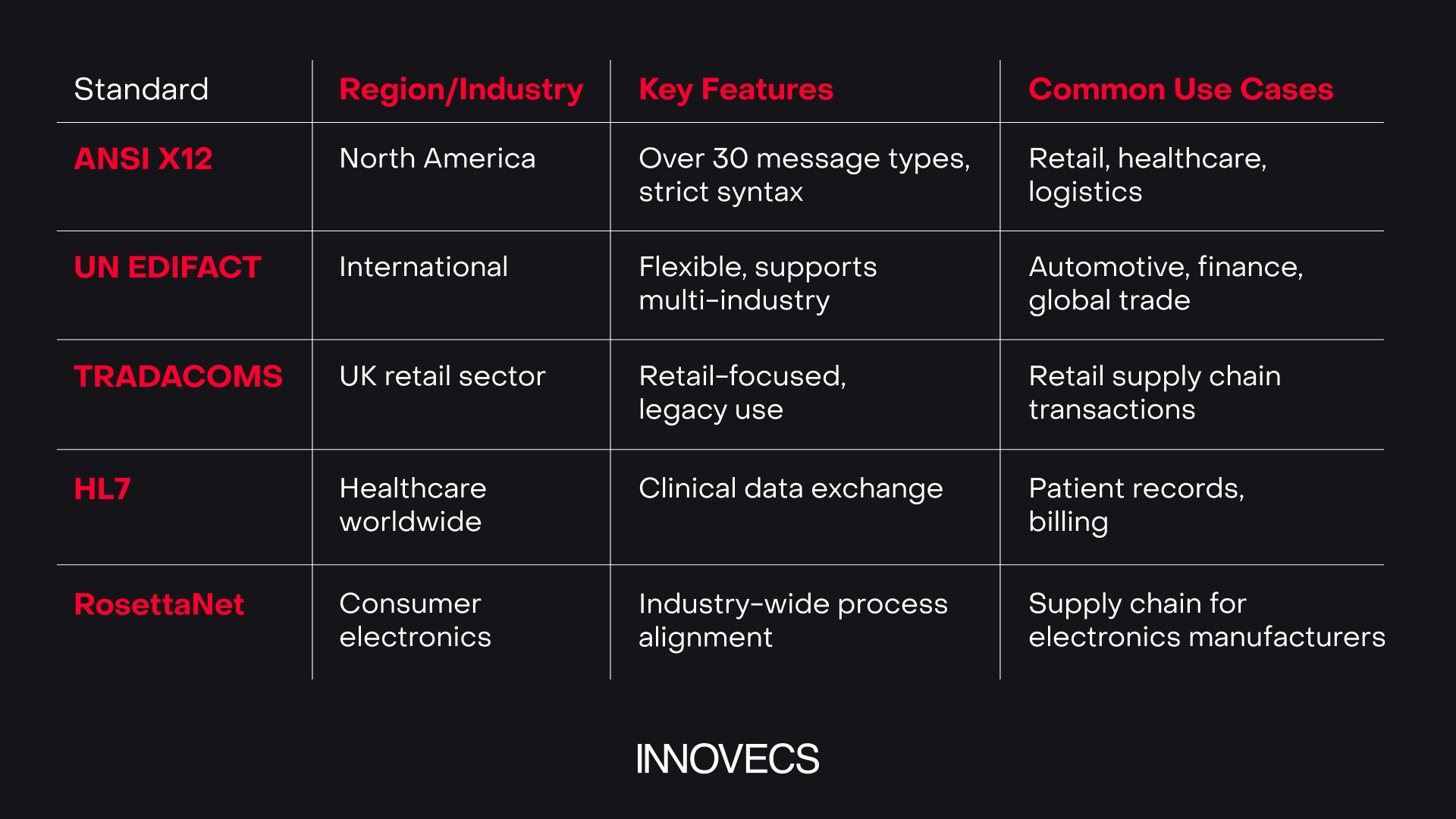
There are multiple EDI standards designed to accommodate the needs of different industries and regions. Below are the most widely used types:
ANSI X12
Developed by the Accredited Standards Committee X12 (ASC X12) under the American National Standards Institute (ANSI), ANSI X12 is the dominant standard in North America. It defines formats for over thirty message types, including purchase orders (850), invoices (810), and shipment notices (856).
ANSI X12’s structured format allows businesses in various sectors such as healthcare, retail, and logistics to exchange electronic business documents efficiently. For example, the HIPAA EDI transaction sets rely heavily on ANSI X12 formats for healthcare claims and eligibility checks.
UN EDIFACT
The United Nations Electronic Data Interchange for Administration, Commerce, and Transport (UN EDIFACT) is an international EDI standard recognized globally, particularly popular in Europe and Asia.
It supports multi-industry exchanges and offers flexible message guidelines that help companies with business processes interface across borders.
UN EDIFACT is widely used by financial institutions, the automotive industry, and the consumer electronics sector. Its international scope makes it ideal for companies involved in worldwide financial messaging network exchanges or dealing with international standard business transactions.
TRADACOMS
Primarily used in the UK retail sector, TRADACOMS is an older EDI document standard focused on retail and supply chain transactions.
Although its usage has declined in favor of newer standards like EDIFACT, it remains important for legacy systems within retail.
HL7
HL7 standards are specific to the healthcare industry and govern the exchange of clinical and administrative data between healthcare providers.
HL7 complements EDI by defining structured formats for patient data, lab results, and billing information, ensuring compliance with privacy regulations such as HIPAA.
RosettaNet Partner Interface Processes
Developed for the consumer electronics and technology sectors, RosettaNet defines industry-wide electronic business documents and processes. It focuses on aligning business processes and software technologies among supply chain partners.
How EDI Standards Work
Understanding how EDI standards operate is essential to grasp how they streamline electronic business communication and support business transactions across industries.
At its core, the EDI process involves converting business documents into a standardized electronic format so they can be automatically transmitted and processed between trading partners without manual intervention.
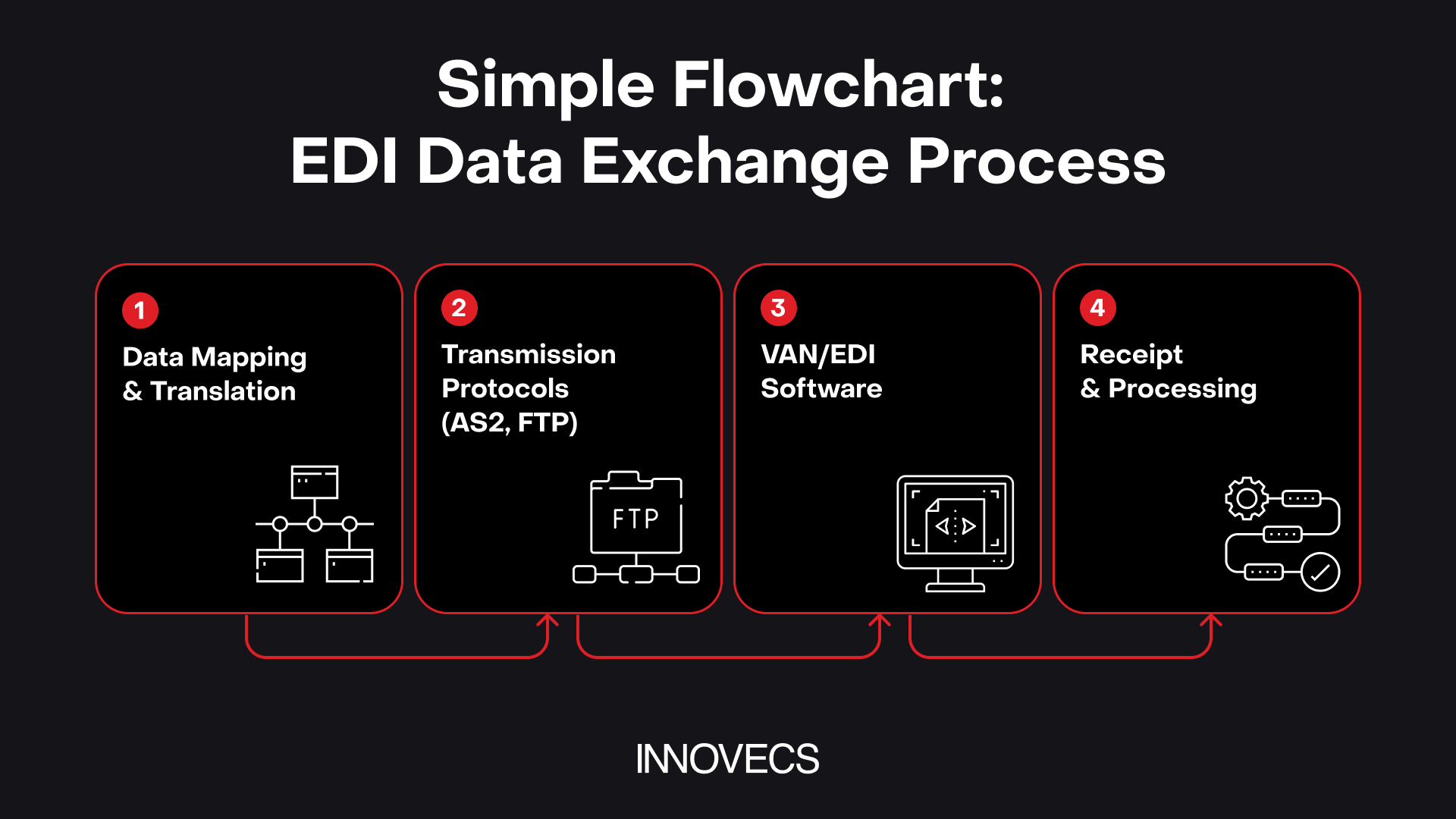
Here’s a breakdown of the main steps involved in EDI data exchange:
- Data Mapping and Translation
The first step is to map the internal data from a company’s computer systems—like ERP or accounting software—into the standard EDI format. This involves converting data elements into the appropriate structure defined by standards like ANSI X12 or UN EDIFACT. Specialized translation software performs this task to ensure compliance with EDI document standards. - Transmission Protocols
Once data is converted into the standardized EDI format, it is transmitted using secure communication protocols such as AS2 (Applicability Statement 2), FTP, SFTP, or through Value-Added Networks (VANs). These protocols guarantee reliable and secure electronic transmission of documents between business partners. - EDI Software and VANs
Companies typically use EDI software to manage, translate, and route messages. Value-added networks (VANs) act as intermediaries or hubs that facilitate message exchange between companies that may not be directly connected. VANs provide services like message tracking, error handling, and data security. - Receipt and Processing
Upon receiving an EDI message, the recipient’s EDI system translates the data back into a readable format that integrates with their internal software. This allows for immediate processing of business information, such as updating inventory or generating invoices.
The entire process results in a standardized format for exchanging business documents, enabling seamless communication across different industry sectors.
Challenges of Implementing EDI Standards
While the benefits of adopting EDI standards are significant, businesses face several challenges during implementation:
- High Initial Setup Costs
Implementing EDI requires investment in software, infrastructure, and training. Small or medium-sized companies often find the upfront costs a barrier to adoption. - Integration Complexity
Aligning EDI with existing software technologies and computer systems can be complex. Different companies use various platforms, and creating a smooth business process interface demands technical expertise. - Ongoing Maintenance and Updates
EDI standards evolve to keep up with industry changes and regulations. Continuous updates, monitoring, and troubleshooting are essential to maintain compliance and system efficiency. - Trading Partner Requirements
Different business partners may use distinct standards or versions. Supporting multiple EDI standards and ensuring compatibility across partners is a technical and operational challenge.
Solutions to Overcome Implementation Challenges
- Partner with EDI Experts: Engaging vendors specializing in EDI solutions can reduce complexity and ensure adherence to standards like ASC X12 or UN EDIFACT.
- Use Cloud-Based EDI Services: Cloud EDI platforms offer scalable, cost-effective options, reducing the need for heavy infrastructure investment and easing integration with business processes.
- Leverage Implementation Frameworks: Structured frameworks guide companies through phased EDI deployment, from pilot testing to full-scale implementation.
- Standardize Internal Processes: Developing consistent business information handling and employee training helps align operations with EDI requirements.
Future of EDI Standards
The landscape of electronic data interchange is evolving rapidly to meet the demands of modern industries and emerging technologies. Here are key trends shaping the future of EDI standards:
- Integration with AI and Machine Learning
Artificial Intelligence (AI) is increasingly being integrated into EDI systems to enable smarter data processing.AI-driven tools can identify patterns, predict errors, and automate complex tasks, reducing manual oversight and improving the accuracy of business transactions.
- Rise of APIs Alongside Traditional EDI
While EDI remains essential, Application Programming Interfaces (APIs) are becoming popular for real-time data exchange.The combination of EDI implementations with APIs allows businesses to achieve more flexible and faster communication, particularly in dynamic industries such as retail and logistics.
- Cloud-Based EDI Solutions
Cloud technology offers scalable and cost-effective platforms for EDI.Cloud-based services reduce the need for costly on-premises infrastructure and allow companies to quickly onboard new trading partners and support extended supply chains.
- Adoption of Industry 4.0 and IoT
The advent of Industry 4.0 and the Internet of Things (IoT) is pushing EDI to evolve beyond traditional document exchange.Integration with smart devices and sensors means data can be exchanged automatically within business processes for enhanced operational efficiency.
- Further Development of Uniform Standards
Organizations such as the American National Standards Institute (ANSI) and the United Nations (UN) continue to update and refine national standards and international EDI protocols like ASC X12 and UN EDIFACT to support new industry requirements and regulatory demands. - Multi-Industry Exchange Expansion
As EDI data usage spreads across various sectors, including automotive, healthcare, retail, and finance, the development of multi-industry, flexible EDI document standards will enable broader interoperability and reduce fragmentation.

Conclusion
EDI standards are a key component of modern electronic business, enabling companies to exchange electronic business documents reliably, accurately, and efficiently.
By adopting standards such as ANSI X12, UN EDIFACT, and industry-specific formats like HL7, businesses can streamline daily business transactions, improve supply chain management, and comply with regulatory requirements.
Despite implementation challenges, the evolution of EDI towards cloud solutions, AI integration, and API coexistence ensures that EDI will remain vital in supporting seamless communication among supply chain partners and business partners worldwide.
For businesses aiming to stay competitive in an increasingly digital marketplace, investing in robust EDI strategies and standards is no longer optional but essential.


